
ITI Electronic Mechanic Amplifier and Oscillator Mock Test 2026
ITI Electronic Mechanic Amplifier and Oscillator Mock Test 2026 is designed for students preparing for ITI exams, NCVT CBT, and technical interviews. This mock test includes important multiple choice questions (MCQs), short questions with answers, and concept-based practice on amplifiers and oscillators.
In this test, you will learn about different types of amplifiers such as voltage amplifier, power amplifier, and classes of amplifiers (Class A, B, AB, C). You will also understand oscillator concepts including Hartley oscillator, Colpitts oscillator, Wien bridge oscillator, and the role of positive feedback.
Explain ITI Electronic Mechanic Mock Test Question Answer
निम्नलिखित में से कौन सी क्लास ए एम्पलीफायर की विशेषता है?
Which of the following is a characteristic of a Class A amplifier?
- उच्च दक्षता || High efficiency
- ऑडियो अनुप्रयोगों के लिए उपयुक्त || Suitable for audio applications
- सीमित बिजली उत्पादन || Limited power output
- कम विरूपण || Low distortion
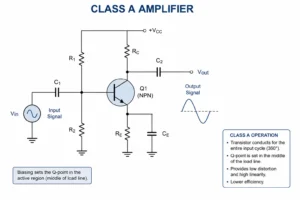
Class A amplifier में transistor पूरे input signal cycle यानी 360° तक conduct करता है। इसलिए output signal बहुत smooth और linear होता है, जिससे distortion बहुत कम होता है।
Options Explanation:
✅ कम विरूपण (Low distortion) — यह Class A amplifier की मुख्य विशेषता है।
❌ High efficiency — गलत, क्योंकि Class A amplifier की efficiency कम होती है, लगभग 25% to 30%।
✅ Suitable for audio applications — यह भी सही concept है, क्योंकि low distortion के कारण इसे audio circuits में use किया जाता है। लेकिन यदि single best answer पूछा जाए, तो Low distortion सबसे direct characteristic है।
❌ Limited power output — यह मुख्य characteristic नहीं है, हालांकि efficiency कम होने के कारण power loss ज्यादा होता है।
Answer: Low distortion / कम विरूपण
Class A amplifier पूरे input signal cycle के दौरान conduct करता है, इसलिए इसका output अधिक linear और smooth होता है। इसी कारण इसमें distortion बहुत कम होता है। इसकी efficiency कम होती है, लेकिन low distortion के कारण इसे audio amplifier applications में use किया जाता है.
सामान्य-उत्सर्जक विन्यास आमतौर पर किस प्रकार के एम्पलीफायर में उपयोग किया जाता है?
A common-emitter configuration is commonly used in which type of amplifier?
- ऑडियो एंप्लिफायर || Audio amplifier
- वोल्टेज प्रवर्धक || Voltage amplifier
- शक्ति एम्पलीफायर || Power amplifier
- धारा प्रवर्धक || Current amplifier
Common-emitter (CE) configuration BJT transistor का सबसे अधिक उपयोग किया जाने वाला amplifier configuration है। इसमें voltage gain बहुत अच्छा मिलता है, इसलिए इसे सामान्यतः voltage amplifier के रूप में use किया जाता है।
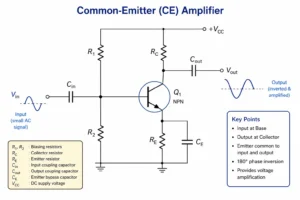
CE amplifier में input signal base पर दिया जाता है और output collector से लिया जाता है। इसका output signal input के मुकाबले 180° phase shift होता है।
Options Explanation:
✅ Voltage amplifier / वोल्टेज प्रवर्धक — सही उत्तर, क्योंकि common-emitter configuration high voltage gain देता है।
✅ Audio amplifier / ऑडियो एंप्लिफायर — CE configuration audio circuits में भी use होता है, लेकिन इसका मुख्य उपयोग voltage amplification के लिए माना जाता है।
❌ Power amplifier / शक्ति एम्पलीफायर — power amplifier के लिए अधिकतर Class B, AB या push-pull circuits use होते हैं।
❌ Current amplifier / धारा प्रवर्धक — current amplifier के लिए common-collector configuration ज्यादा उपयुक्त होता है।
Answer: Voltage amplifier / वोल्टेज प्रवर्धक
Common-emitter configuration का उपयोग सामान्यतः voltage amplifier में किया जाता है, क्योंकि यह high voltage gain प्रदान करता है। इसमें input base पर दिया जाता है और output collector से प्राप्त किया जाता है। CE amplifier output signal को input signal की तुलना में 180° phase shift करता है।
एक एम्पलीफायर में बायसिंग सर्किट का उद्देश्य क्या है?
What is the purpose of a biasing circuit in an amplifier?
- ऑपरेटिंग बिंदु को स्थिर करने के लिए || To stabilize the operating point
- विकृति दूर करने के लिए || To eliminate distortion
- प्रतिक्रिया प्रदान करने के लिए || To provide feedback
- लाभ बढ़ाने के लिए || To increase the gain
Amplifier में biasing circuit का मुख्य उद्देश्य transistor को सही operating point (Q-point) पर बनाए रखना होता है। Q-point वह स्थिति है जहाँ transistor बिना input signal के सही तरीके से operate करता है।
यदि biasing सही नहीं होगी, तो amplifier का output signal distorted हो सकता है या transistor cutoff/saturation में जा सकता है। इसलिए biasing circuit transistor को active region में रखकर stable amplification में मदद करता है।
Options Explanation:
✅ To stabilize the operating point / ऑपरेटिंग बिंदु को स्थिर करने के लिए — सही उत्तर, क्योंकि biasing circuit transistor का Q-point stable रखता है।
❌ To eliminate distortion / विकृति दूर करने के लिए — biasing distortion को कम करने में मदद कर सकती है, लेकिन इसका मुख्य उद्देश्य distortion को पूरी तरह eliminate करना नहीं है।
❌ To provide feedback / प्रतिक्रिया प्रदान करने के लिए — feedback circuit अलग होता है, जो gain, stability या distortion control के लिए use किया जाता है।
❌ To increase the gain / लाभ बढ़ाने के लिए — gain बढ़ाना biasing circuit का primary purpose नहीं है। Gain amplifier design और components पर depend करता है।
Answer: To stabilize the operating point / ऑपरेटिंग बिंदु को स्थिर करने के लिए
Amplifier में biasing circuit का उपयोग transistor के operating point या Q-point को स्थिर रखने के लिए किया जाता है। सही biasing transistor को active region में रखती है, जिससे amplifier input signal को सही तरीके से amplify कर सके। यदि biasing proper न हो, तो output signal में distortion आ सकता है या transistor cutoff/saturation में जा सकता है।
एक एम्पलीफायर का लाभ आमतौर पर इसमें व्यक्त किया जाता है:
The gain of an amplifier is typically expressed in
- एम्पीयर || Amperes
- डेसिबल || Decibels
- (dB)वाट्स || Watts
- (V)वोल्ट || Volts (V)
Amplifier का gain यह बताता है कि amplifier input signal को कितना बढ़ाता है। Gain voltage, current या power के रूप में हो सकता है, लेकिन इसे सामान्यतः decibel (dB) में express किया जाता है।
Decibel (dB) एक logarithmic unit है, जो input और output signal के ratio को दर्शाती है। इसलिए amplifier gain को compare करने और measure करने के लिए dB का उपयोग किया जाता है।
Options Explanation:
✅ Decibels (dB) / डेसिबल — सही उत्तर, क्योंकि amplifier gain सामान्यतः dB में express किया जाता है।
❌ Amperes (A) / एम्पीयर — यह current की unit है, gain की नहीं।
❌ Watts (W) / वाट्स — यह power की unit है, gain की नहीं।
❌ Volts (V) / वोल्ट — यह voltage की unit है, gain की नहीं।
Answer: Decibels (dB) / डेसिबल
Amplifier का gain input signal की तुलना में output signal कितना बढ़ा है, यह बताता है। Gain को सामान्यतः decibel (dB) में व्यक्त किया जाता है, क्योंकि dB input और output के ratio को logarithmic रूप में दर्शाता है। Ampere current की unit, Watt power की unit और Volt voltage की unit है, इसलिए ये gain की standard unit नहीं हैं।