DC generators are one of the most important topics in ITI Electrician, especially for students preparing for ITI exams Railway Exam, interviews, and viva sessions. Many learners search for DC Generator Questions and Answers in Hindi because understanding technical concepts in a familiar language makes preparation easier and more effective. Whether you are a diploma student, ITI trainee, engineering learner, or someone revising basic electrical machines, a well-organized set of questions can be extremely helpful.
In this article, you will find a practical collection based on 50 DC Generator Questions and Answers in Hindi, explained in English for wider understanding. The idea is to give you a ready reference that can support both written exam preparation and oral viva practice. The questions are presented in Hindi, while the explanations and structure of the article are kept natural and clear in English.
This guide has been arranged in two main sections. The first section gives the Top 50 DC Generator Questions and Answers, while the second section works as a Hindi Guide to DC Generator Viva Questions. Together, these sections provide a balanced study resource that is simple, informative, and useful for quick revision.
Top 50 DC Generator Questions and Answers
DC generator is a machine that converts mechanical energy into electrical energy in the form of direct current. It works on the principle of electromagnetic induction, which states that whenever a conductor cuts magnetic flux, an emf is induced in it. This is one of the most basic and important questions asked in exams and viva. Students are often expected not just to define a DC generator, but also to explain its working principle in a short and confident manner.
Before going into the question list, it is useful to remember the main parts of a DC generator: yoke, pole core, pole shoe, field winding, armature core, armature winding, commutator, and brushes. Understanding these parts helps in answering most of the conceptual questions. In many Hindi viva sessions, examiners ask direct questions about construction, function of each part, and the difference between generator action and motor action.
Below is a useful list of 50 DC Generator Questions and Answers in Hindi. The questions are written in Hindi as requested, while the answers are also kept in Hindi for authenticity and direct study use. This format is especially beneficial for students who want a ready-made viva and exam preparation set.
1. DC जनरेटर क्या है?
उत्तर: DC जनरेटर एक विद्युत मशीन है जो यांत्रिक ऊर्जा को प्रत्यक्ष धारा (DC) विद्युत ऊर्जा में बदलती है।
2. DC जनरेटर किस सिद्धांत पर कार्य करता है?
उत्तर: यह फैराडे के विद्युत चुंबकीय प्रेरण सिद्धांत पर कार्य करता है।
3. DC जनरेटर का मुख्य कार्य क्या है?
उत्तर: इसका मुख्य कार्य यांत्रिक ऊर्जा से DC वोल्टेज उत्पन्न करना है।
4. DC जनरेटर के मुख्य भाग कौन-कौन से हैं?
उत्तर: योक, पोल कोर, पोल शू, फील्ड वाइंडिंग, आर्मेचर, कम्यूटेटर और ब्रश।
5. योक का क्या कार्य है?
उत्तर: योक मशीन को यांत्रिक मजबूती देता है और चुंबकीय फ्लक्स के लिए मार्ग प्रदान करता है।
6. पोल कोर का क्या कार्य है?
उत्तर: पोल कोर फील्ड वाइंडिंग को सहारा देता है और चुंबकीय फ्लक्स उत्पन्न करने में मदद करता है।
7. पोल शू का क्या कार्य है?
उत्तर: पोल शू चुंबकीय फ्लक्स को समान रूप से फैलाता है।
8. फील्ड वाइंडिंग क्या है?
उत्तर: फील्ड वाइंडिंग पोल पर लिपटी हुई कुंडली होती है जो चुंबकीय क्षेत्र बनाती है।
9. आर्मेचर क्या है?
उत्तर: आर्मेचर वह घूर्णन भाग है जिसमें emf प्रेरित होती है।
10. आर्मेचर कोर किससे बना होता है?
उत्तर: यह पतली-पतली सिलिकॉन स्टील लैमिनेशन से बना होता है।
11. लैमिनेशन का उपयोग क्यों किया जाता है?
उत्तर: एडी करंट हानि को कम करने के लिए लैमिनेशन का उपयोग किया जाता है।
12. कम्यूटेटर क्या है?
उत्तर: कम्यूटेटर एक यांत्रिक रेक्टिफायर है जो आर्मेचर में उत्पन्न AC को DC में बदलता है।
13. ब्रश का क्या कार्य है?
उत्तर: ब्रश कम्यूटेटर से विद्युत धारा को बाहरी परिपथ तक पहुंचाते हैं।
14. DC जनरेटर में किस प्रकार की धारा उत्पन्न होती है?
उत्तर: आर्मेचर में AC उत्पन्न होती है, लेकिन कम्यूटेटर की मदद से आउटपुट DC मिलती है।
15. emf का पूर्ण रूप क्या है?
उत्तर: इलेक्ट्रोमोटिव फोर्स।
16. उत्पन्न emf किन कारकों पर निर्भर करती है?
उत्तर: फ्लक्स, चालक की संख्या, घूर्णन गति और समानांतर पथों की संख्या पर निर्भर करती है।
17. DC जनरेटर का emf समीकरण क्या है?
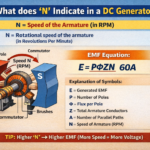
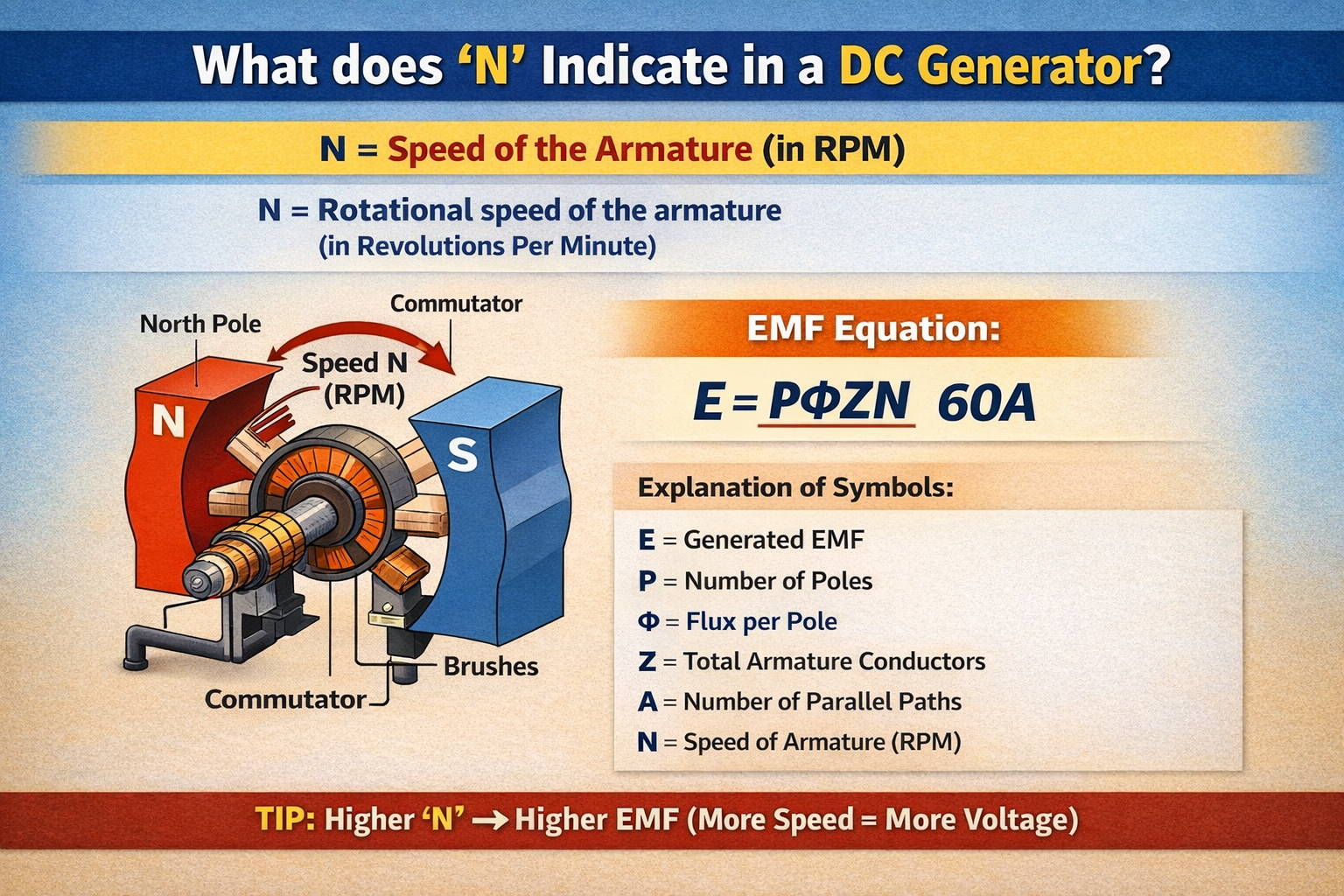
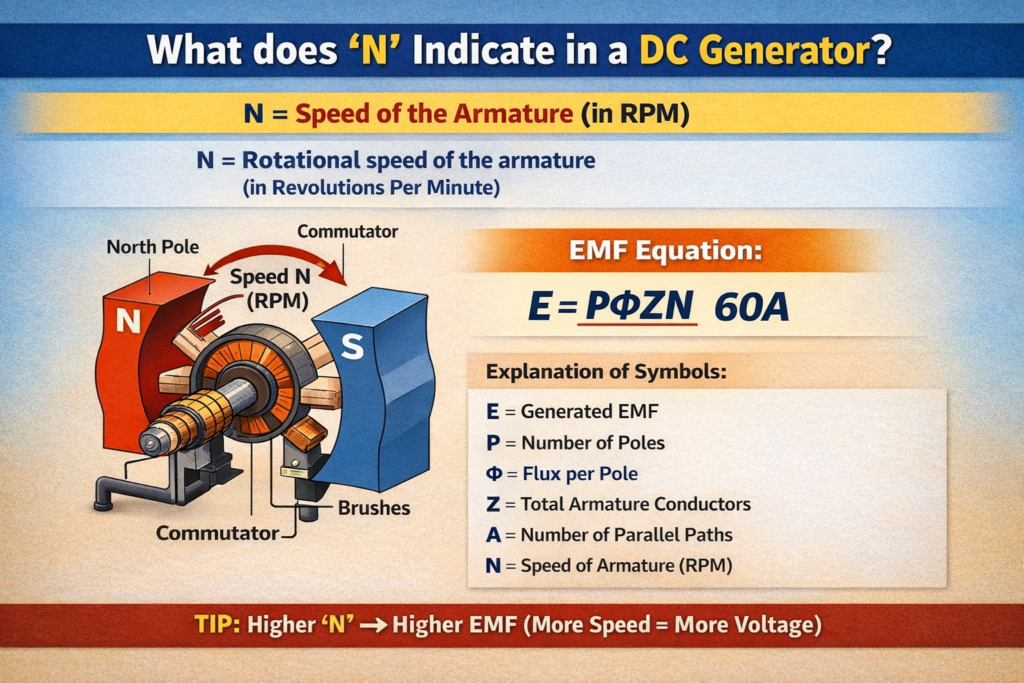
उत्तर: E = (P × Φ × Z × N) / (60 × A)
18. P किसे दर्शाता है?
उत्तर: P पोलों की संख्या दर्शाता है।
19. Φ किसे दर्शाता है?
उत्तर: Φ प्रति पोल फ्लक्स को दर्शाता है।
20. Z किसे दर्शाता है?
उत्तर: Z आर्मेचर कंडक्टरों की कुल संख्या दर्शाता है।
21. N किसे दर्शाता है?
उत्तर: N आर्मेचर की गति (RPM) दर्शाता है।
22. A किसे दर्शाता है?
उत्तर: A समानांतर पथों की संख्या दर्शाता है।
23. DC जनरेटर के कितने प्रकार होते हैं?
उत्तर: मुख्यतः पृथक उद्दीप्त (Separately Excited) और स्वउद्दीप्त (Self Excited)।
24. Self Excited जनरेटर कितने प्रकार के होते हैं?
उत्तर: शंट, सीरीज और कंपाउंड जनरेटर।
25. शंट जनरेटर क्या है?
उत्तर: जिसमें फील्ड वाइंडिंग आर्मेचर के समानांतर जुड़ी होती है, उसे शंट जनरेटर कहते हैं।
26. सीरीज जनरेटर क्या है?
उत्तर: जिसमें फील्ड वाइंडिंग लोड के साथ श्रेणीक्रम में जुड़ी होती है, उसे सीरीज जनरेटर कहते हैं।
27. कंपाउंड जनरेटर क्या है?
उत्तर: जिसमें शंट और सीरीज दोनों प्रकार की फील्ड वाइंडिंग होती हैं, उसे कंपाउंड जनरेटर कहते हैं।
28. कंपाउंड जनरेटर के प्रकार कौन-कौन से हैं?
उत्तर: लॉन्ग शंट और शॉर्ट शंट।
29. Residual Magnetism क्या है?
उत्तर: पोल में बचा हुआ थोड़ा चुंबकत्व residual magnetism कहलाता है।
30. Residual magnetism क्यों आवश्यक है?
उत्तर: प्रारंभिक emf उत्पन्न करने के लिए यह आवश्यक है।
31. DC जनरेटर build up क्यों करता है?
उत्तर: residual magnetism और सही field connection के कारण वोल्टेज build up होता है।
32. जनरेटर build up न होने के कारण क्या हैं?
उत्तर: residual magnetism का न होना, गलत field connection, अधिक field resistance, कम speed।
33. Critical field resistance क्या है?
उत्तर: वह अधिकतम field resistance जिस पर जनरेटर voltage build up कर सके।
34. Critical speed क्या है?
उत्तर: वह न्यूनतम गति जिस पर जनरेटर voltage build up कर सके।
35. Armature reaction क्या है?
उत्तर: आर्मेचर फ्लक्स का मुख्य फ्लक्स पर प्रभाव armature reaction कहलाता है।
36. Armature reaction का प्रभाव क्या होता है?
उत्तर: इससे फ्लक्स विकृत होता है और emf कम हो सकती है।
37. Commutation क्या है?
उत्तर: कम्यूटेटर के माध्यम से आर्मेचर धारा की दिशा बदलने की प्रक्रिया commutation कहलाती है।
38. Poor commutation के कारण क्या हैं?
उत्तर: ब्रश की गलत स्थिति, अधिक लोड, खुरदुरा कम्यूटेटर, खराब संपर्क।
39. Equalizer ring का उपयोग कहाँ होता है?
उत्तर: Lap winding में equalizer ring का उपयोग किया जाता है।
40. Equalizer ring का क्या कार्य है?
उत्तर: यह असमान emf के कारण उत्पन्न circulating current को कम करता है।
41. Lap winding कहाँ उपयोग होती है?
उत्तर: कम वोल्टेज और अधिक धारा वाले जनरेटर में।
42. Wave winding कहाँ उपयोग होती है?
उत्तर: अधिक वोल्टेज और कम धारा वाले जनरेटर में।
43. Brush किस पदार्थ के बने होते हैं?
उत्तर: सामान्यतः कार्बन या ग्रेफाइट के बने होते हैं।
44. Interpoles क्या हैं?
उत्तर: मुख्य poles के बीच लगे छोटे poles interpoles कहलाते हैं।
45. Interpoles का क्या कार्य है?
उत्तर: ये commutation सुधारते हैं और sparking कम करते हैं।
46. DC जनरेटर की efficiency क्या है?
उत्तर: आउटपुट पावर और इनपुट पावर का अनुपात efficiency कहलाता है।
47. DC जनरेटर में हानियाँ कौन-कौन सी हैं?
उत्तर: कॉपर लॉस, आयरन लॉस, मैकेनिकल लॉस, stray losses।
48. Copper loss क्या है?
उत्तर: वाइंडिंग के resistance के कारण होने वाली शक्ति हानि copper loss कहलाती है।
49. Iron loss कितने प्रकार की होती है?
उत्तर: Hysteresis loss और Eddy current loss।
50. DC जनरेटर के उपयोग क्या हैं?
उत्तर: बैटरी चार्जिंग, इलेक्ट्रोप्लेटिंग, DC welding, excitation of alternators, और laboratory purposes।
These 50 questions cover almost every basic point related to DC generators. If a student learns these properly, it becomes much easier to answer both objective and viva-based questions. The set begins with definition and principle, then moves toward construction, working, losses, winding types, and practical uses. This progression is useful because it mirrors how most teachers and examiners ask questions.
Another benefit of this Hindi question-answer format is confidence building. Many students know the concepts but hesitate during viva because they cannot frame short answers quickly. By practicing these standard Hindi responses, they can improve both accuracy and fluency. It also helps in technical interviews where fundamental electrical questions are asked in simple language.
Hindi Guide to DC Generator Viva Questions
In a viva examination, the examiner usually does not start with highly advanced theory. Instead, the questions begin with simple definitions such as what a DC generator is, what principle it works on, and what its main parts are. That is why students should first master the basic language of the topic. If the foundation is clear, even slightly tricky questions become manageable. A good viva answer should be short, correct, and spoken with confidence.
Students preparing through a Hindi medium often understand the machine well but struggle when questions are twisted slightly. For example, the examiner may ask the difference between armature winding and field winding, or why the commutator is called a mechanical rectifier. Some may also ask practical questions such as why voltage fails to build up, why brushes spark, or why lamination is used. These are common viva-style questions because they test actual understanding rather than memorization alone.
To perform well in DC generator viva, students should revise answers in sequence: definition, principle, construction, emf equation, types, losses, armature reaction, commutation, and applications. This order makes recall easier. It is also helpful to practice speaking the answers aloud in Hindi, because viva performance depends not just on memory but also on clarity of expression. Repetition of these 50 questions can significantly improve oral performance.
A smart strategy for viva preparation is to divide the topic into small groups. First learn all questions about the parts of DC generator, then move to working principle and emf equation, then to types of generators, and finally to losses and applications. This method reduces confusion and helps in long-term retention. Students should not try to memorize everything at once. Instead, they should understand the reason behind each answer.
Another important point is that viva examiners often ask connected questions. For example, after asking “DC generator किस सिद्धांत पर कार्य करता है?” they may immediately ask “फैराडे का नियम क्या है?” or “कम्यूटेटर का क्या कार्य है?” That means students need to prepare in chains, not in isolation. One answer should naturally lead to the next related topic. This improves readiness and shows a deeper understanding of the subject.
Finally, learners should remember that DC generator viva is not just about theory; it is also about observation of the machine. If you have seen a real machine in the lab, identify the commutator, brushes, poles, field winding, and armature physically. Practical familiarity makes your answers stronger and more natural. Even if you are preparing from notes only, visualizing the machine while answering will make your responses sharper and more confident.
To sum up, this article on 50 DC Generator Questions and Answers in Hindi is designed as a practical study resource for students who want to strengthen their basics and prepare effectively for exams and viva sessions. The combination of English explanation and Hindi question-answer format makes it especially useful for learners who are comfortable understanding concepts in English but prefer revision in Hindi.
The 50 questions included here cover the most essential areas of DC generators, including definition, working principle, construction, types, emf equation, losses, commutation, armature reaction, and applications. These are exactly the kinds of points that are repeatedly asked in technical education and electrical viva examinations. With regular practice, these answers can help students respond quickly and correctly.
If you are preparing for an ITI, diploma, polytechnic, or engineering viva, this guide can serve as a strong revision tool. Read the questions daily, try to speak the answers aloud, and connect each answer with the actual working of the machine. That simple habit can make a big difference in confidence and performance.
- 50 DC Generator Questions and Answers in Hindi
 DC generators are one of the most important topics in ITI Electrician, especially for students preparing for ITI exams Railway Exam, interviews, and viva sessions. Many learners search for DC Generator Questions and Answers in Hindi because understanding technical concepts in a familiar language makes preparation easier and more effective. Whether you are a diploma … Read more
 - 75 Important Hindi Q&A for AITT Electrician Exam Prep75 Key Hindi Q&A for AITT Electrician Theory Prep Preparing for the All India Trade Test (AITT) in the Electrician trade requires solid command over theory and applied knowledge. Candidates often look for reliable short question–answer sets in Hindi to strengthen key concepts and save revision time. This article brings together a structured list of … Read more
- Soldering Most Important Question Answer In HindiMost Important Soldering Interview Question Answer in Hindi PDF for ITI and All Type Technical Examination (UPPCL TG – II) soldering questions and answers pdf Soldering Question Answer Soldering Question Answer PDF
- Important DC Circuits Questions Answers in HindiImportant MCQ questions and answers of series combination and parallel combination of DC circuit combination for the students of ITI Electrician, which are asked in all types of competition exams and for the students of ITI Electrician, what are these questions from DC circuit every year? There are all types of questions in DC circuit … Read more
- ITI Electrician Basic Electricity Important Short QuestionsBoost your exam preparation with our comprehensive guide to ITI Electrician Basic Electricity short questions. Master essential concepts like Ohm’s Law, circuits, and electrical safety with expert-curated Q&A designed for NCVT/SCVT success. Perfect for quick revision and acing your technical interviews! ITI Electrician Basic Electricity Important Short Questions